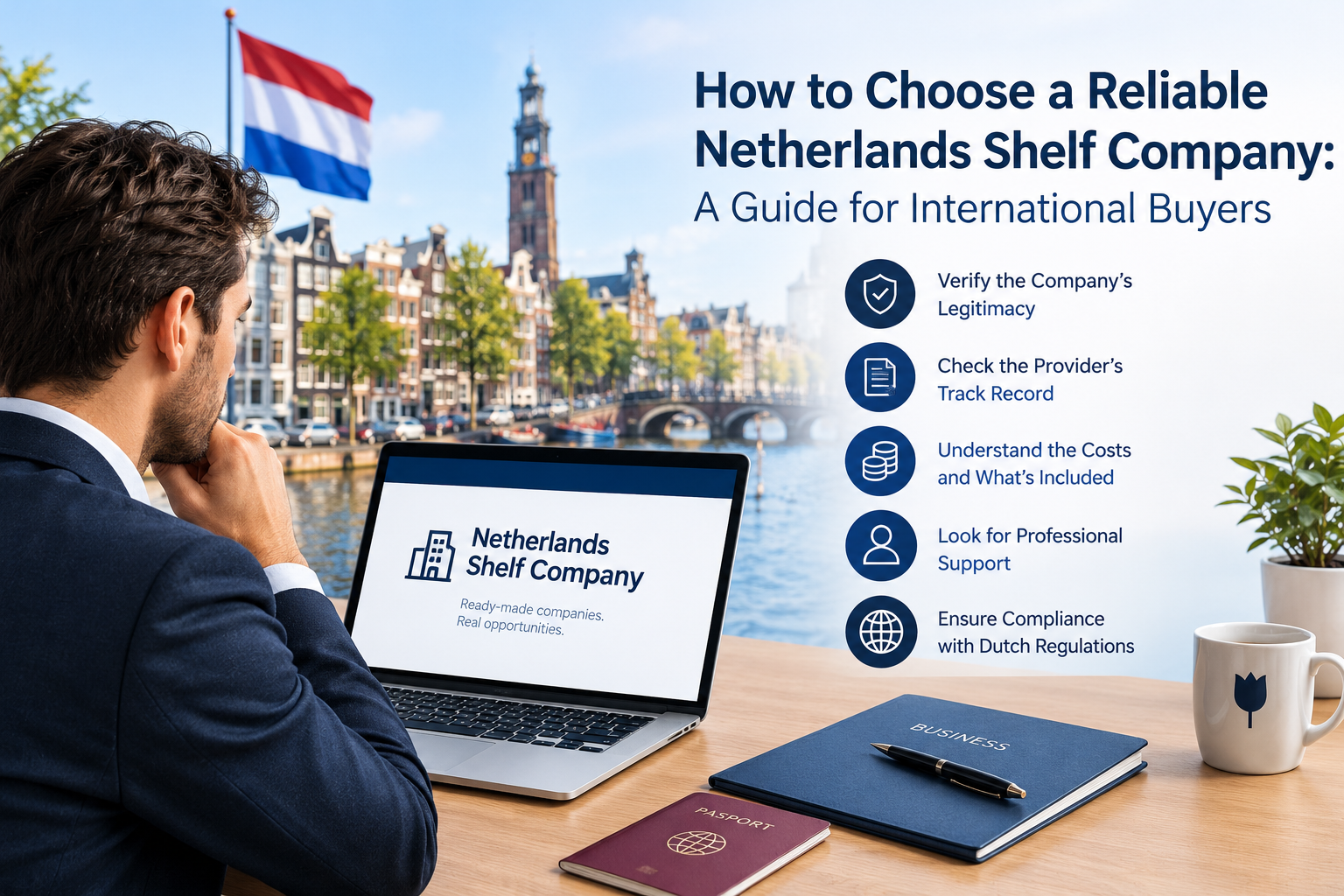
How to Choose a Reliable Netherlands Shelf Company: A Guide for International Buyers
Buying a Netherlands shelf company can be a practical way to acquire an existing Dutch corporate entity. However, the right purchase is not simply the company that can be transferred fastest or has the oldest incorporation date.
For international buyers, choosing a suitable Dutch shelf company requires a clear understanding of its corporate history, financial position, legal obligations, and suitability for the intended business.
A company that appears straightforward on paper may have outstanding liabilities, incomplete records, previous commercial activities, or obligations that are not immediately obvious.
At [Your Company Name], we help international clients approach Dutch shelf company acquisition in a structured and informed way, with a focus on appropriate checks, efficient coordination, and transparent communication.
What Makes a Netherlands Shelf Company Suitable for Purchase?
A suitable shelf company should meet your commercial requirements and withstand appropriate due diligence.
Important factors include its legal structure, registration status, corporate documents, financial history, ownership records, and any existing obligations.
The company should also be appropriate for your intended activities. A structure that works for one business may not be suitable for another because of licensing, tax, banking, regulatory, or operational requirements.
Seven Checks to Make Before Buying a Dutch Shelf Company
1. Verify the company’s registration
Check the company’s details in the Dutch Chamber of Commerce (KVK) Business Register.
Confirm its legal name, registration number, legal form, registration details, and recorded officials as relevant.
A registration extract is a useful starting point, but it does not independently prove that a company has no debts or legal disputes.
2. Review the company’s financial history
Ask for relevant financial records and determine whether the company has conducted business previously.
Depending on its history, the review may include annual accounts, balance sheets, profit and loss statements, bank records, and bookkeeping information.
A company described as dormant should still be checked to establish whether its records support that description.
3. Investigate potential liabilities
A share acquisition generally transfers ownership of the existing legal entity, rather than creating a completely new company.
The company may retain its existing debts, contracts, obligations, and potential claims after the transfer.
Due diligence should therefore consider tax liabilities, creditor claims, guarantees, litigation, contractual commitments, and any other relevant exposure.
Appropriate contractual protections may also be considered with professional advice.
4. Confirm the ownership and corporate records
Review the company’s articles of association, share ownership records, and relevant corporate documents.
Confirm that the seller has the authority to transfer the shares and that the transaction can be completed in accordance with the company’s governing documents and Dutch law.
For a Dutch BV, the transfer generally requires a Dutch civil-law notarial deed.
5. Check tax and filing compliance
Determine whether the company has outstanding tax returns, payment obligations, annual accounts, or other compliance matters.
The appropriate checks depend on the company’s age, activities, financial history, and applicable reporting obligations.
Do not assume that a company with little or no apparent activity has no outstanding compliance requirements.
6. Assess banking and business suitability
If you intend to apply for a business bank account, payment services, credit facilities, or supplier accounts, assess the requirements before acquiring the company.
Banks and other providers may consider the company’s ownership, history, business model, expected transactions, and the identity and location of its beneficial owners.
A shelf company does not automatically qualify for a bank account, financing, or a particular payment service.
7. Confirm that the structure fits your business plan
Consider the intended activities, target markets, ownership arrangements, tax position, and operational requirements.
A Dutch BV may be suitable for many legitimate commercial purposes, but some industries require licences, registrations, or additional regulatory approvals.
Professional advice can help determine whether an existing BV is the right choice or whether incorporating a new company would be more appropriate.
Is an Older Dutch Shelf Company Better Than a New One?
Not necessarily.
Some buyers look for an older company because they believe its incorporation date may be commercially useful. However, the age of a company does not establish its creditworthiness, trading history, reputation, or suitability for a particular purpose.
A company that has existed for several years may have an extensive history that requires careful review. A newly incorporated BV may offer a simpler starting point for a buyer who prefers a new legal entity.
The decision should be based on verified facts, commercial needs, and the results of due diligence, rather than age alone.
Why Use a Professional Shelf Company Acquisition Service?
For buyers based abroad, checking a Dutch company’s history and coordinating the transaction can be challenging.
Different aspects of the acquisition may involve the seller, a Dutch civil-law notary, an accountant, a tax adviser, and other service providers.
A coordinated one-stop-shop service can help organise these steps, clarify responsibilities, and identify potential issues before the transaction proceeds.
Our support can include company sourcing, due diligence coordination, share transfer arrangements, corporate updates, and introductions or coordination for accounting, tax, and other agreed services.
The scope of each engagement is tailored to the transaction. Independent legal, financial, and tax advice should be obtained where appropriate.
Your Netherlands Shelf Company Acquisition Checklist
Before committing to a purchase, confirm that you have:
- Reviewed the company’s registration details.
- Examined its corporate documents and ownership records.
- Investigated its financial and tax history.
- Considered existing debts, obligations, and potential claims.
- Confirmed the seller’s authority and the share transfer requirements.
- Assessed whether the company suits your intended activities.
- Obtained a clear quotation covering the purchase and associated services.
- Understood the post-acquisition reporting and compliance requirements.
These checks help establish a more informed basis for your decision.
Buy a Netherlands Shelf Company with Greater Confidence
A successful acquisition starts with choosing the right company, understanding the transaction, and making informed decisions before completion.
Shelf Company EU-Netherlands assists international buyers seeking a Netherlands shelf company through a coordinated and transparent process.
Whether you are looking for a Dutch BV for international trade, consulting, investment-related activities, or another legitimate business purpose, we can discuss your requirements and help identify an appropriate route forward.
Contact us to discuss available Netherlands shelf companies, due diligence requirements, acquisition costs, and the additional services you may need.
This article provides general information and does not replace transaction-specific legal, accounting, or tax advice. Due diligence reduces uncertainty but cannot eliminate every risk. The buyer should obtain appropriate professional advice before completing an acquisition.